Page 5 of the Coon Rapids Enterprise, Thursday, May 26, 2011 has our story
Energy Grass growth test begins near Manning
Also, same story on the front cover of the Manning Monitor today, Thursday June 2, 2011.
Thursday, June 2, 2011


Poking out
We finally have sunshine and heat! And wow is the gras growing! We dug up a few rhizomes over the past weekend to be sure they were growing. Sure enough they were starting to sprout out new shoots. Very small though. Since then we have had temps in the 90's and lots of sunshine (and some evening rain). The rhizomes I planted in a pot outside my back door sprouted on May 31st and haven't stoped since. I even planted it in junk clay soil to test the worst conditions I could. So I am feeling much better about the rhizomes taking off.


Friday, May 27, 2011
Rain and publicity
Nothing but rain since planting. A few nice warm days in between, and overall good weather. Almost 4 inches of rain since planting. It would be nice to warm up some.
A nice article was included on page 9 of the May 28, 2011 Iowa Farmer Today. I couldn't find the article online though.
A nice article was included on page 9 of the May 28, 2011 Iowa Farmer Today. I couldn't find the article online though.
Saturday, May 21, 2011
We're in the ground!
On Wednesday May 18th we were able to get the rhizomes in the ground. A good rain fell Friday morning and Friday night that should set the scene for great growth. We hope to see some leaves breaking the soil soon.
An article in the local paper about the receiving of the grant was published in the Denison Bulletin.
During planting John Klein formally of the M&M divide RC&D visited and wrote a new article about our endeavors and distributed that around. I hope to see more on that soon.
Planting got started early around 8:30 am on a great spring day. Rob sat with me on the back to plant rhizomes while Denny drove. We found the rate of rhizomes went fairly well. Rob and I fed about as fast as we could and Denny adjusted the speed of the tractor to adjust the rate per acre. Rob and I could see down the tube really well to make sure our approximate spacings were correct. The high rate plot was placed on 40" rows and 6" apart. This was altered from out original plan so that we would not plant double rows. The benefit of double rows did not seem worth it when we got into the field. if we find issues with the growth of 6" spacing we will make note and adjust next time.The mid population density was aimed to be 9" apart, but we also ran up to 12" a time or two while getting the speed right. The low population runs were 18" apart. The low population is more in the lines of large plantation style plant populations and seemed very straight forward if we were to do a much larger area.
Of the rhizomes, we received roughly 1,000 to a box. We were able to measure our work to how fast we went through boxes of rhizomes. For the high density plot, each of the 4 500' runs took roughly 20 minutes and 2 full boxes to complete. The low population density plot took only 10 minutes and one box to complete. The middle range plot ran around 1.25 to 1.5 boxes each run.
The planter worked out really well. It dug a 4 inch furrow where the rhizomes were dropped into. then about 2" of dirt filled in on top of the rhizome followed by a packer wheel to increase the soil contact. When it was all done there were some good deep furrows in the field. It was visible that some rhizomes needed better cover. We expected to harrow the field. This was done and smoothed out the field. The rhizomes after the harrow work were about 4" deep in loose packed soil.
There was a 20' stretch in one pass during the middle population where the plows came up too high and were not covering the rhizomes. It turned out to be a great example to view how the rhizomes were planted. After these pictures, we brought the planter back right beside the line and buried the rhizomes again.


Below is an older video I wanted to post of the planter in operation. This video was early on. One of the first field tests. After this video what was changed is mentioned in some posts below to optimize it for rhizomes, otherwise, very good operation.
An article in the local paper about the receiving of the grant was published in the Denison Bulletin.
During planting John Klein formally of the M&M divide RC&D visited and wrote a new article about our endeavors and distributed that around. I hope to see more on that soon.
Planting got started early around 8:30 am on a great spring day. Rob sat with me on the back to plant rhizomes while Denny drove. We found the rate of rhizomes went fairly well. Rob and I fed about as fast as we could and Denny adjusted the speed of the tractor to adjust the rate per acre. Rob and I could see down the tube really well to make sure our approximate spacings were correct. The high rate plot was placed on 40" rows and 6" apart. This was altered from out original plan so that we would not plant double rows. The benefit of double rows did not seem worth it when we got into the field. if we find issues with the growth of 6" spacing we will make note and adjust next time.The mid population density was aimed to be 9" apart, but we also ran up to 12" a time or two while getting the speed right. The low population runs were 18" apart. The low population is more in the lines of large plantation style plant populations and seemed very straight forward if we were to do a much larger area.
 |
| Fist run of the season |
 |
| final design planter in operation |
The planter worked out really well. It dug a 4 inch furrow where the rhizomes were dropped into. then about 2" of dirt filled in on top of the rhizome followed by a packer wheel to increase the soil contact. When it was all done there were some good deep furrows in the field. It was visible that some rhizomes needed better cover. We expected to harrow the field. This was done and smoothed out the field. The rhizomes after the harrow work were about 4" deep in loose packed soil.
 |
| finished planting |
 |
| This was about half done planting |
 |
| Pulling the harrow through the furrows |
 |
| After harrowing, the rhizome is just below my fingers. The soil level is at my thumb |


Below is an older video I wanted to post of the planter in operation. This video was early on. One of the first field tests. After this video what was changed is mentioned in some posts below to optimize it for rhizomes, otherwise, very good operation.
Wednesday, May 11, 2011
Ready to Roll
We received the miscanthus rhizomes last week, and found out what we were dealing with.
 | ||
| Boxes of rhizomes |
 |
| Rhizomes is a box |
The rhizomes varied is size. Most were a generid size of a finger with some roots attached. Every now and then there was a root that was close to the size of an entire hand.
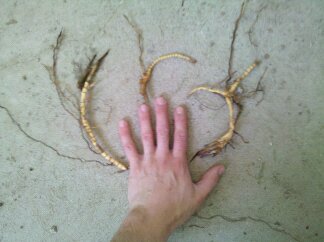 |
| Three standard rhizomes by my hand |
This past weekend we were able to get the planter ready to go. After seeing the rhizomes we did a little re-design to get the planter ready to go.
We configured the drop tube to be a 6" PVC pipe that dropped center on the row. this let us add a nice seat behind the basket, and raise the basket to a workable height. We had to remove the old wheel packers, and rather changed them out for some old International planter packer wheels we had available.
 |
| Planter from behind |
 |
| Added wings to the original plow shanks to prevent dirt from filling it the furrow |
 |
| Side of the planter, taken when a little dark, but you can see the parts. |
Tuesday, April 19, 2011
Rhizomes
We are getting miscanthus rhizomes from my partner company out of Canada, New Energy Farms. they are a great resource on miscanthus and have been producing the rhizomes for several years now. The order was placed after the grant was awarded, but due to spring weather and other shipping requirements, the rhizomes are planned to ship April 25, and they should arrive by that weekend on the 29th. The ground is wet, and getting more soaked by the day. Even snow in the North parts of Iowa. We have had off and on drizzle for the past week. Many farmers around are waiting on the weather as well. A few local row-crops went in during mid-April but nothing substantial due to cold soil temperatures and wet conditions. Soil temperature as of April 18 was 42 Degrees F, which is warm enough for miscanthus to go Iowa State Soil Temps. We are now waiting for things to dry up.
The miscanthus plants are noninvasive, asexual rhizomes of the Illinois clone family. The grass is determined to be the best high yielding biomass plants. The plants are also very efficient. They use deep roots to access water reserves, and use the above ground foliage to soak nutrients from the atmosphere. When the plant goes dormant in the late fall, the nutrients return to the roots ready for the next season. NEF video
To achieve the 3 population densities that we are planting we will plant double rows for the mid- and high-population densities of 16,000 and 24,000 rhizomes per acre, and single rows for the low population density control of 8,000 rhizomes. Each row will be 40" apart, and the double rows will be between 10" and 20" apart on 40" centers. the high population will be an extremely high density planting every 12" in each row. The mid-range population will be planted every 16" in a row. This is assumed as the best range for optimal growth. Most studies do not dig rhizomes after a single year, and so we hope the high population does well to speed the propagation of rhizomes. High multiplication of rhizomes is critical to our farm establishing a large plot of miscanthus. The low population plot will be planted every 16"-18" in the single row. This can be seen as risky due to the likelihood of some of the plants not growing as desired. This will leave large blank spots in the field of no-growth. The low population plot is designed to mimic establishment plots, not propagation plots, and will not be dug up. It will rather be monitored for the full two years to see how well the plants spread and fill in over each growing season.
Planter test

Published with Blogger-droid v1.6.8
Subscribe to:
Posts (Atom)