Showing posts with label biomass. Show all posts

Tuesday, July 5, 2011

Slow and steady

On July 3rd, I was able to make it out to the farms and have a good look at the miscanthus plot. We were also lucky enough to have Emily Heaton from Iowa State University meet us to have a quick tour. We were able to discuss the plot, growing expectations, equipment & labor, and talk about general practices and shared lessons learned over years of growing miscanthus as well as other research and personal projects. I look forward to sharing our experiences into the future with what works, what doesn't, and how to logistically make a biomass crop really work.

As traditional Iowa farmers, my dad and I can easily look as our new grass plot and say that it looks terrible. The nearby corn is approaching shoulder height, and the grass is far behind other nearby established brome grass.  But this is a new plant, and we have to change our mindsets. Upon closer inspection, there are a lot pf plants coming, and they seem to be doing well.
First view entering the plot. Quite a bit of foxtail in this area, but this is right next to the driveway entrance to the field. Same vantage point as many other previous pictures.

This is at the top of the hill in the middle of the plot. A few really good rows are visible without a lot of weeds around. The tall skinny grass is the miscanthus, everything else are weeds.
 
There needs to be a broad-leaf pesticide application soon, but it really looks like the miscanthus might make it! Emily assured us that the stand of first year rhizome grass looked really good. Her pleasant surprise helped calm our original doubts.

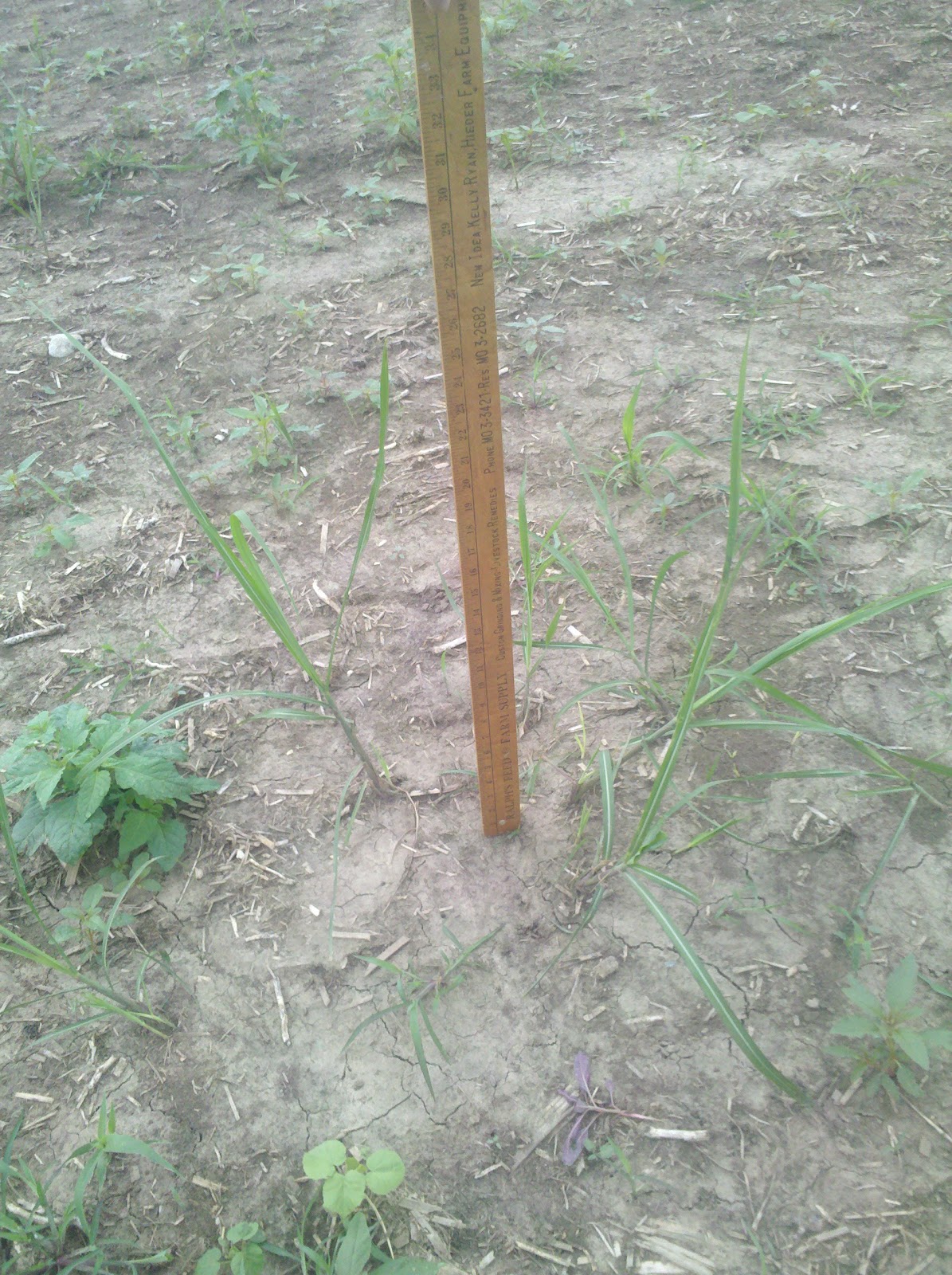
I got a yardstick and took a couple pictures of a few plants. I would guess that about 75% of plants are up, and of them 50% or better look like these plants below with the rest still very small as if they just came out of the ground. It will be better to see again after the broad-leaves are killed off.

25" single plant lots of good looking leaves.

Good sized plant, 4+ separate plants coming out of the same rhizome.

Smaller plant here 10" in height and only a few leaves, this is the general middle range of plants out there at this time

Another good medium sized plant. The terrace grass is in the background.

Saturday, May 21, 2011

We're in the ground!

On Wednesday May 18th we were able to get the rhizomes in the ground. A good rain fell Friday morning and Friday night that should set the scene for great growth. We hope to see some leaves breaking the soil soon.

An article in the local paper about the receiving of the  grant was published in the Denison Bulletin.

During planting John Klein formally of the M&M divide RC&D visited and wrote a new article about our endeavors and distributed that around. I hope to see more on that soon.

Planting got started early around 8:30 am on a great spring day. Rob sat with me on the back to plant rhizomes while Denny drove. We found the rate of rhizomes went fairly well. Rob and I fed about as fast as we could and Denny adjusted the speed of the tractor to adjust the rate per acre. Rob and I could see down the tube really well to make sure our approximate spacings were correct. The high rate plot was placed on 40" rows and 6" apart. This was altered from out original plan so that we would not plant double rows. The benefit of double rows did not seem worth it when we got into the field. if we find issues with the growth of 6" spacing we will make note and adjust next time.The mid population density was aimed to be 9" apart, but we also ran up to 12" a time or two while getting the speed right. The low population runs were 18" apart. The low population is more in the lines of large plantation style plant populations and seemed very straight forward if we were to do a much larger area.
Fist run of the season

final design planter in operation
Of the rhizomes, we received roughly 1,000 to a box. We were able to measure our work to how fast we went through boxes of rhizomes.  For the high density plot, each of the 4 500' runs took roughly 20 minutes and 2 full boxes to complete. The low population density plot took only 10 minutes and one box to complete. The middle range plot ran around 1.25 to 1.5 boxes each run.

The planter worked out really well. It dug a 4 inch furrow where the rhizomes were dropped into. then about 2" of dirt filled in on top of the rhizome followed by a packer wheel to increase the soil contact. When it was all done there were some good deep furrows in the field. It was visible that some rhizomes needed better cover. We expected to harrow the field. This was done and smoothed out the field. The rhizomes after the harrow work were about 4" deep in loose packed soil.
finished planting
This was about half done planting
Pulling the harrow through the furrows
After harrowing, the rhizome is just below my fingers. The soil level is at my thumb
There was a 20' stretch in one pass during the middle population where the plows came up too high and were not covering the rhizomes. It turned out to be a great example to view how the rhizomes were planted. After these pictures, we brought the planter back right beside the line and buried the rhizomes again.

Below is an older video I wanted to post of the planter in operation. This video was early on. One of the first field tests. After this video what was changed is mentioned in some posts below to optimize it for rhizomes, otherwise, very good operation.

Tuesday, April 19, 2011

Rhizomes

We are getting miscanthus rhizomes from my partner company out of Canada, New Energy Farms. they are a great resource on miscanthus and have been producing the rhizomes for several years now. The order was placed after the grant was awarded, but due to spring weather and other shipping requirements, the rhizomes are planned to ship April 25, and they should arrive by that weekend on the 29th. The ground is wet, and getting more soaked by the day. Even snow in the North parts of Iowa. We have had off and on drizzle for the past week. Many farmers around are waiting on the weather as well. A few local row-crops went in during mid-April but nothing substantial due to cold soil temperatures and wet conditions. Soil temperature as of April 18 was 42 Degrees F, which is warm enough for miscanthus to go Iowa State Soil Temps. We are now waiting for things to dry up.

The miscanthus plants are noninvasive, asexual rhizomes of the Illinois clone family. The grass is determined to be the best high yielding biomass plants. The plants are also very efficient. They use deep roots to access water reserves, and use the above ground foliage to soak nutrients from the atmosphere. When the plant goes dormant in the late fall, the nutrients return to the roots ready for the next season. NEF video

To achieve the 3 population densities that we are planting we will plant double rows for the mid- and high-population densities of 16,000 and 24,000 rhizomes per acre, and single rows for the low population density control of 8,000 rhizomes. Each row will be 40" apart, and the double rows will be between 10" and 20" apart on 40" centers. the high population will be an extremely high density planting every 12" in each row. The mid-range population will be planted every 16" in a row. This is assumed as the best range for optimal growth. Most studies do not dig rhizomes after a single year, and so we hope the high population does well to speed the propagation of rhizomes. High multiplication of rhizomes is critical to our farm establishing a large plot of miscanthus. The low population plot will be planted every 16"-18" in the single row. This can be seen as risky due to the likelihood of some of the plants not growing as desired. This will leave large blank spots in the field of no-growth. The low population plot is designed to mimic establishment plots, not propagation plots, and will not be dug up. It will rather be monitored for the full two years to see how well the plants spread and fill in over each growing season.

Planter test

More to come. 1st field test without rhizomes. New reconfigured 2 row planter.
Published with Blogger-droid v1.6.8